
Mosaic of moments: Joachim Trier’s Sentimental Value
The author covers Joachim Trier in several articles: a general overview of motifs and devices, on Oslo, August 31st (here), Louder Than Bombs (here), Thelma, in three articles (here, here and here), and The Worst Person in the World (here). Another major article on The Worst Person in the World on Montages is “Sculpting Time” by film professor Anne Gjelsvik.
This article will reveal the entire plot of the film. You should see it before reading.
*
The opening shot of Sentimental Value, the sixth feature film directed by Joachim Trier and co-written with Eskil Vogt, moves from a city of the living to the domain of the dead.
This slow sweep starts with buildings in the distance, where people live and work, and ends up gazing at a cemetery. This is a place where generations often share the same grave, and when the second shot materialises, a tantalising view of a villa in Swiss chalet style1, this too will be a location where memories and echoes of many generations linger.
Further linkage: like the cemetery, the Borg family house is heavily surrounded by trees and bushes, a fact continually emphasised in the following shots, where the camera is gliding along the house in hypnotic, enchanting movements and angles, virtually every image making sure to include lots of greenery. Even when we are close to the wall looking up at a window, it contains a rich reflection of trees. The unusual style of the villa, its distinctive colouring of dark brown with rust red details, the foreboding shadow from a tree intruding upon it, the intensification of the camera closing in during the establishing shot, plus the estrangement effect of the following camerawork – all help conjure up a powerful sense of mystery.
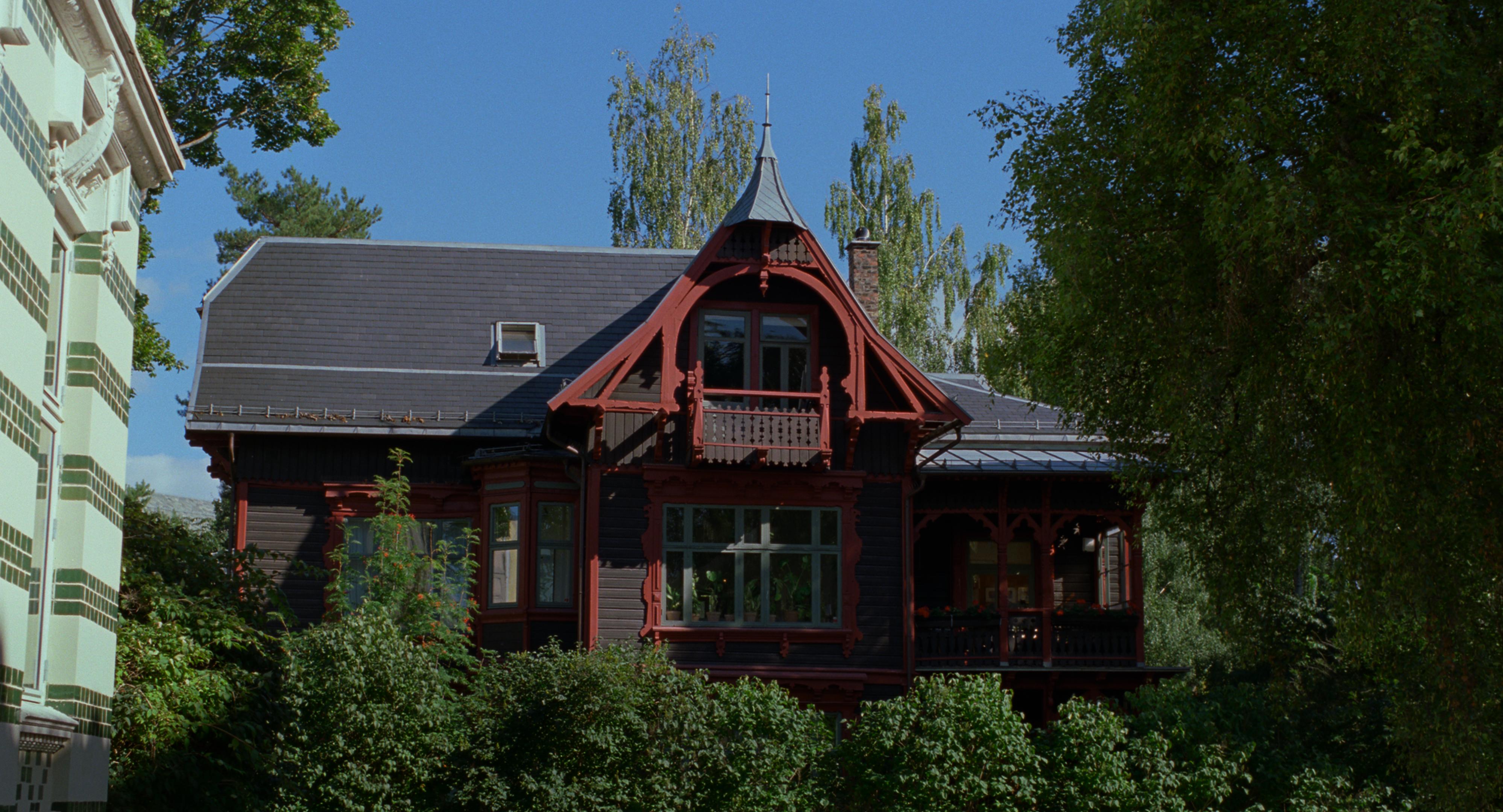
As we shall explore later, the opening shot’s exterior trajectory from life to death is further echoed inside this house, in an all-important corridor that connects the living room to a room where a suicide happened. The hero of Sentimental Value is Gustav Borg (Stellan Skarsgård), an ageing, formerly celebrated director who has not made a feature film in fifteen years.2 A flashback shows the magical idyll of his childhood being abruptly terminated at the age of seven, when his mother walked through that corridor to hang herself in 1958.
This is one link in the traumas that keep marching on down the generations in Sentimental Value. The source is all the way back in World War II, when she, a resistance fighter, was imprisoned and tortured at Grini concentration camp. Having faced evil each day for two years probably left untreated emotional scars that finally became too much to bear. The war connection is not far-fetched for Trier: his grandfather, pioneering film director Erik Løchen, was in the resistance too, as well as the mother of the famous Norwegian actress Bente Børsum, who at 91 is doing the voice-over in Sentimental Value. Børsum’s mother was similarly scarred by the war, and, like Gustav Borg, left her family. For more about his angle, confer film professor Anne Gjelsvik‘s Montages analysis (direct link to this particular topic here).

Now Gustav has written a comeback film trying to get to terms with this suicide – a probable root cause of his attachment issues and self-centredness – and he wants his estranged daughter Nora (Renate Reinsve), an acclaimed theatre actress, to play the heroine. The script has her commit suicide at the end of the story, which is to be shot in the family house, with the death involving the very same corridor and room where Gustav’s mother died. Unbeknownst to him (or is it?), the emotionally unstable Nora herself has a suicide attempt behind her. Like her grandmother was traumatised by the war and Gustav by her suicide, Nora seems to have been damaged by his stormy marriage rife with enraged quarrelling, and devastated by Gustav’s departure after the divorce, practically disavowing his family in pursuit of a career as a filmmaker. This traumatised Nora’s mother as well. Nora was probably about twelve at the time and the extent of their contact since then is unclear (discussed here).
The room is even further connected to suicide: like Gustav intends to double the real house as a film location, in a highly unusual turn Trier is boldly reusing the house where the climactic long take in his own Oslo, August 31st (2011) took place, ending with the hero’s intentional overdose, even in the same room.

If you know Trier’s work well, Sentimental Value presents an intertextual jolt already at the outset. Perhaps it was the gaze at the cemetery just before, lingering just enough to signal meaningfulness, but at the very instant I saw the house, Oslo, August 31st sprung magically to mind, even though I did not recognise the building.

Perhaps the sight of Oslo in the very first seconds also helped subtly evoke the earlier film. Remarkably, two central aspects of Sentimental Value are introduced with equal subtlety. The severity of Nora’s emotional volatility is revealed, and even then merely hinted at, not until a third into the film, when her sister Agnes (Inga Ibsdotter Lilleaas) shows concern. The very early sequence where a hysterical Nora repeatedly refuses to go on stage can be ascribed to (abnormal) stage fright – and the outsize drama and its comedic elements distract us from taking it entirely seriously. In retrospect, however, it is a sign of something far worse.
In fact, the sequence also serves as a rough foreshadowing of the main action. Nora refuses to act, like she rejects the role in Gustav’s film, but after a series of tribulations she will come through, with the reaction from the audience after the stage performance mirrored by her father’s response at the end of the film, where she is paradoxically back on a stage. This is a milder form of how the prologue in Louder Than Bombs (2015), with its family drama, and recent death of a loved one, a forerunner of Sentimental Value, closely mirrored the rest of the action, as described here.
Furthermore, suicide is not mentioned until even later, and then only gradually introduced, during the scene where Gustav is taking Rachel Kemp (Elle Fanning), the Hollywood star who has replaced Nora after the rejection, through the steps of the final scene. Adding to the Oslo, August 31st connection, the dawning realisation that Gustav’s film too shall be about suicide, and indeed end with one, is chilling – and deliciously disorienting! – even more so when Gustav announces this as well will be captured in one long take.

As central as the house is, this has often been exaggerated in the media, for it is the location only for well under half of the action. Unlike Trier’s Oslo trilogy, the streets of the city have very little presence here, packed as Sentimental Value already is with characters, time planes, strands back into history, complex flashback sections not always in chronological order – and seasons, stretching from winter through autumn. There is another curious similarity to Oslo, August 31st, however, because from a certain point, immediately after the fascinating “Persona dissolves“, the action suddenly becomes compressed, with almost the rest of the film taking place within twenty-four hours.

Except for Nora’s hysterical stage fright drama, there are no bravura situations, unlike in Thelma (2017) and The Worst Person of the World, what I called “non-submersible units”, discussed here and here. Trier’s distinctive form of sober inventiveness is present as always, but Sentimental Value is a calmer, more contemplative work, and even his trademark montage sections are more relaxed. The camera work seems more mobile, more seductive, however, with lots of discreet but nevertheless intensifying forward movements. Humour is less prominent than in Worst Person but still effective, and Trier’s fondness of mini-portraits of peripheral characters is still with us, with a micro-portrait one of a worked-up psychologist patient (Ingrid Vollan) especially memorable. As usual, the casting (by Trier regular Yngvill Kolset Haga) is outstanding, down to the most minute role, and everything feels natural.
Mosaic of moments
At 133 minutes, it is Trier’s longest film and has a novelistic feel. It comes across as a mosaic of moments, with a complexity that requires further viewings to fully unravel. Although audiences are probably reacting to them on a subconscious level, most of the analytical points in this article are invisible to the eye on a first viewing, based on cues and meaningful patterns hiding in plain sight among natural surroundings, and submerged in the flow of the upper layer of the storytelling.
Memories have always been an obsession with Joachim Trier, for example the chorus of voices kicking off Oslo, August 31st, reminiscing about their lives in the city. In Sentimental Value the theme is front and centre, but also in a seemingly throw-away yet calmly stunning moment about the lack of memory, as Nora tears a strip off a cupboard and throws it away. It said “do not forget to turn off the hotplate”. Typical of the film’s economy with exposition, this is the only indicator that the illness of Nora’s mother before her death was dementia.3 With this paradoxically simple action, months, maybe years of memories, work and worry about her affliction are reduced to a minuscule object easily discarded.
Nora as a twelve-year-old wrote a school essay imagining the Borg house to be a living being, a metaphor that permeates the film, so it is not only its inhabitants but also the building itself that possesses memories. Its importance is emphasised by the fact that the flashback voice-over begins with the story of the essay, and as an example of the film’s many subtle flourishes, precisely at that point there is an exterior shot of the house where someone seems to have carved an “R” and possibly an “A” on the wall – as if Nora has not only written about the house, but also on it. It is tempting to stretch the metaphor even further, that the film itself often feels like a conscious entity, the flashbacks being its memories, and as an intelligent creature that seeks order and sense, this results in the vast number of intertwinings, rhymes, echoes and recurring motifs that will be so central to this article.

As for favourite Trier motifs, his beloved person-in-foreground-out-of-focus shot is only used twice in this film, with Nora on the edge of disaster in front of the theatre audience, and in depression before her apartment window. In the latter case, the camera performs an arc around her, shifting her into focus but ending up in front of yet another window, perhaps indicating that she is trapped in this state. Entrapment-by-window is also suggested as the sisters, like deer in the headlights, observe megastar Rachel Kemp’s arrival at the Borg house – and even more so, when we watch through no less than three windows a defeated Gustav lurching towards his liquor after Rachel has withdrawn from his film. He is trapped in the house and all the memories, without the movie that was supposed to be his way out of the past.

Trier has been fond of them before as well, and precisely windows are the most important visual motif in Sentimental Value. The voice-over retelling Nora’s essay compares those of the Borg house to eyes looking out at the world, and over the course of the film, to almost mystical effect, we share its stoical view from a large number of rooms.4 Trier makes sure every floor is involved, so it observes the running children in the first flashback from the basement, and looks down on Gustav drinking outside from an attic. The five-pane window of the living room is the most prominent one – serving also as a visual anchor for understanding where the action occurs – directly across from the suicide room. In the stripped-down state of the Borg house and at Nora’s apartment, the lack of curtains seems designed to make the motif starker, with window frames naked and no distractions from the view. The unusually high number of long shots within the house, very often framing characters in doorways, may suggest that the house is observing them even inside.
Gustav Borg and his daughters
Gustav and the two daughters form the nucleus of the story, with Rachel as substitute character, taking over from Agnes as the lead actress in a Gustav Borg film and replacing Nora as the heroine of his new work.5
Gustav is self-centred and manipulative. Quite a few artists have been awful people in everyday life, as if their driven nature, the one that makes it possible to reach their highest artistic levels, outside the laboratory of art causes them to trample down others. But through the artistic process they get in touch with a better aspect of their personality. So this terrible person is nevertheless able to give great gifts, in the profound impact his films have on audiences, like Rachel in Deauville – but most strikingly in Sentimental Value, the fact that his script becomes an inflection point for his daughters to rediscover childhood’s unconditional love for each other.

There is also this complicated man’s selfless generosity towards Rachel when she withdraws from his film, praising her for the bravery of telling it to his face, going to great lengths to ensure she will not get traumatised by the defeat, while he himself hides that he is crushed, immediately afterwards throwing himself at the bottle. It will be his only companion as he sits down at the table where there will be no more read-throughs.
Is he only able be so magnanimous because for a while to him Rachel has been “the most important, and best person in the world”? Echoing the title of The Worst Person in the World, these are Agnes’s words for how Gustav made her feel, for a spell, when as a child she played the lead in “Anna”, the Gustav Borg film shown in a retrospective of his work at the Deauville Film Festival. 6 During their confrontation scene Agnes cannot understand how her father can just turn it on and off, be so “intimate and genuine and then just disappear” out of her life again. Thus, a lot of the dramatic tension of Sentimental Value arise from how Rachel becomes a substitute daughter – look how proud Gustav is of her when she is introduced to Agnes! – while his own children remain in the emotional periphery.
An important undercurrent is how actors and crew become tools that a director is using for “selfish” ends to make the best possible film, and any powerful emotional attachments others form are only temporary. His children are extreme examples, but Gustav certainly has no general interest in keeping in touch. He has not seen such an all-important figure as his regular cinematographer since their last film fifteen years ago, we come to understand in a great scene. Not only do we get a fine mini-portrait of the phlegmatic Peter (Lars Väringer), but Skarsgård is priceless, with his utterly ashamed and sheepish look towards his old friend, after Gustav has signalled he has rejected Peter for the film, shocked by his now reduced physical state.

As for Nora, there is a predictable trajectory to her encounters with Gustav. When he presents his new screenplay to her at the restaurant (Lorry, famous in Oslo; Trier is a regular!), he speaks condescendingly about her highly successful theatre career, the foundation of the entire identity of this woman without a family of her own, and her many sarcasms just keep bouncing off his armour of confidence. She almost always delivers them with a smile and this seems to be the usual mode among his daughters – even the very slight disagreement between Nora and Agnes after the funeral is performed with broad smiles, a brilliant acting choice. Also, his term “our house”, blithely insinuating himself back into the family, seems to enrage Nora, as the final deal-breaker.

During the birthday party for Agnes’s son, things seem to improve. She is genuinely amused by Gustav’s gift of DVDs gloriously inappropriate for a nine-year-old and from the smile he sends her, it seems he is aware of this. Perhaps the gift is most of all a mischievous provocation towards Agnes’s bourgeois lifestyle? This is something the free-spirited Nora can understand. She follows up by making fun of Agnes’s husband Even (Andreas Stoltenberg Granerud) and his preoccupation with his phone, asking if he has an agreed-upon limited screen-time like his little boy – playing up to Gustav to whom Even, having nothing to do with the arts, is an absolute non-entity.8 Out smoking together afterwards father and daughter now seem in perfect alignment.
Soon, however, the old mechanisms kick in again. Gustav holds forth with contempt about actresses and their cravings for attention, ignores Nora’s (attention-craving) attempts to insert remarks about her successful theatre work, recommends having children to get something more than art to care about, although being extremely far from leading by example. Worst of all, he eagerly talks about Rachel Kemp, who has so easily dethroned his daughters as the most important person in the world. Nora takes to her sarcasms again, now not so smiling.

When Agnes, constantly out to build bridges, defends Gustav – even though Nora’s remarks cut to the very bone of Gustav’s hypocritical platitudes and failings as a father – this seems to be the final straw that will send Nora tumbling into a heavy depression over her next scenes. From her look towards Agnes and the length of the close-up, this seems to be the most unbearable of it all. To Nora, it is a traitorous act from the person closest to her – especially since Agnes is well aware of Nora’s suicide attempt, while the oblivious Gustav announces his pride in how well his children have turned out.
This comes on top of Nora’s fresh shock that Jakob (Anders Danielsen Lie), a married fellow actor with whom she has an affair, has suddenly broken up with her, and in a cowardly, incredibly vague manner that must be both infuriating and crushing for her. Gustav manages to make this worse by criticising her for being alone. In one of the film’s many subtle touches, there is a playground with children in the foreground as a dejected Nora arrives at the birthday – foreshadowing the fact that the coming conversation will end with talk about children.

The same trajectory over one evening for Nora will repeat itself in a longer arc for Agnes. After having researched her grandmother’s wartime trauma and attained a deeper perspective on how losing his mother to suicide at seven might have formed Gustav’s personality, she looks upon him with fresh eyes, and seeing him in her own nine-year-old playing outside the kitchen window. Soon, they become even more intertwined when she observes Gustav’s childlike delight in teaching the boy filmmaking tricks in the park. One of the trick shots makes it even appear that they are reversed in size. Gustav is surprised at Agnes’s warm hug and harmony seems established.
So when he wants her boy to play the heroine’s son in the film, she is inclined to allow it. When he turns up later with the script to finalise the deal, however, he is at his most selfishly driven, like a commander that will brook no interference. Worst of all, he is blatantly lying about why he did not turn up at Nora’s “Hamlet” premiere, not caring at all that the lie is wholly transparent. Nothing else than his film exists now. He admits freely that he has gone behind Agnes’s back and talked to the boy about the role.9 Gustav is shot from an angle and lit in a way that makes him look like a wizened old obsessive, his eyes small and ice-cold.
When he senses that Agnes might actually refuse, one of the most truthful moments of Sentimental Value occurs, of such astounding emotional violence that this author cannot, on every viewing, hold back a disgusted moan. The camera set-up changes, for one shot only, from over-the-shoulder shots placing us intimately inside the situation, to a wide framing of the two of them, to give us a privileged, objective view so that we can luxuriate in its cruelty.
The automaton that now is Gustav thinks “I must manipulate her” and there is a marked pause, as if to let the calculated nature of the action sink in. Then he puts his hand on her arm, claiming that when she acted in his film it was the most beautiful memory of his life. The father-daughter relationship is only a card to be played, his touch in icy contrast to her earlier spontaneous, heartfelt hug.

Agnes must be thinking, “my father is a monster” – and in the wide shot it is clear that Skarsgård sits in a vaguely abnormal way, his shoulders hunched up strangely – not least, since “beautiful” is exactly the word he is always using, in the most superficially insincere way, in his serial ingratiating bullshitting so pervasive all through the story. When he then starts going on and on about Rachel Kemp, how much the boy’s presence would mean to her, his lack of concern for Agnes brutally contrasted, she finally snaps and refuses to comply, maybe for the first time in her life standing up to her father. (When she later visits Nora, it is with near-pride that she announces, “I quarrelled with Dad yesterday”.)
How can this be the same person that moves over to warmly embrace Rachel, comforting her out of her guilty feelings of having withdrawn from his film? As if to invite comparison, that scene too shifts from over-the-shoulder to a wide shot, when the hug happens.

Gustav’s manipulative touch is an amplified echo of a another gesture of fake intimacy, when during the actors’ picnic Nora touches Jakob’s arm and offers her support if he needs someone to talk to. This happens after it becomes clear that everyone in the company except Nora, his supposed lover, is aware of Jakob’s impending divorce, but at the news there is no concern in her face for a guy who might be going through a difficult time, just a kind of childish eagerness at an opportunity to expand her time with him.
After having blithely accepted the obvious lie – echoing Gustav’s to Agnes – of his lame explanation of why he has not told her about the divorce, she seems to clumsily try to ingratiate herself with him by that awkward touch and a sudden attempt at warmth, an intimacy she has until now not shown much interest in. He is so unimpressed that his attention is hardly on her at all, for in a very nice Trier touch, he soon starts giggling at the antics of the others further away.
Touches like these form a pattern towards the end of the film. Like Gustav in the park, Nora, uncomfortable with intimacy, seems startled when Agnes touches her hand in the bedroom during their reconciliation scene. Then Agnes crawls into her bed, where Nora, unafraid now, embraces Agnes’s head. Later, in the hospital, a now fully comfortable Nora repeats this with the unconscious Gustav: first caressing his hand, then touching his head, something that Gustav responds to in his stupor. In perhaps the film’s most memorable moment, Agnes’s so nakedly compassionate, tearful gaze at Nora, as her sister is revived by reading Gustav’s script, is moving in itself – but greatly supported by the way her hands are touching her own face, resting in them, comforted by them. And what a striking contrast to Gustav’s manipulative gaze at Agnes the day before, and even more his look of utter shame at his cinematographer earlier.

In the bed, Agnes in Nora’s protective grip seems to relish the feeling of being a little girl again, when her big sister shielded her from the problems in the household, their mother unable to act like a parent after Gustav’s departure, by taking care of Agnes and making sure she got to school. Crawling into another person’s bed is precisely something a child would do, and the scene strongly resonates with an earlier bed scene, where Nora is lying side by side with Agnes’s son Erik (the very charming and natural Øyvind Hesjedal Loven). His sweet “I love you” and her playful response “I love you too” are exactly echoed by the sisters here – half-embarrassed by the big word but sincere – to the extent that Nora’s “You too” is followed by “…or, I love you too”, as if to make sure that the magic word is spoken out loud by her too, as well as making the alignment with the earlier scene perfect. (Amazingly, Agnes’s line was improvised so either it nevertheless builds on the earlier scene – which could explain Nora oddly changing her line in midstream, as if Reinsve is realising the echo – or it means that the Nora-Erik scene was amended and filmed afterwards.)
Healing through making art is important in Sentimental Value, but also through experiencing it, for the sisters here through their collective reading of the script – like going to the movies together and be profoundly moved can enable us to talk about hitherto unspoken things.22 The film also demonstrates that personal experiences can cause one to be moved by different things. In the key scene read by both, Rachel’s emotions seem to be triggered by the part of wanting a former lover back, and Nora by the “I cannot do this any more – I cannot do this alone”, which might resonate with her suddenly feeling powerless to do the play early on, or the breakdown during rehearsal, in addition to a repressed yearning for a home.

The former is Elle Fanning‘s big scene, a touching mixture of genuine feelings and trying a bit too hard. It is nevertheless enough to win over Ingrid Berger (celebrated Swedish actress Lena Endre, happy to take on a tiny role for Trier), who until now has attended the table readings with a permanently quizzical, sceptical look, probably not cool about Rachel getting every ounce of Gustav’s attention. She warmly embraces the Hollywood star, who bursts out, “I wish her mother was like this in the film”. Apparently, her mother in the script is not very caring. To this, Gustav again responds with his enigmatic “Exactly” but the situation seems to have given him great food for thought. Is it an impulse to make a change to the script? Or an acknowledgement of the ability of art to use the raw material of lived life and change it, play around with it to gain insights?
The sisters reflect common tendencies in a broken family. Agnes tries to correct the parents’ mistakes by creating a healthy home, and even tries to build bridges between Nora and Gustav to reconstruct their childhood family. Nora eschews family life altogether, unwilling to risk repeating the mistakes. Her self-centred and art-focussed life makes her not unlike her father. The brief scene of her doing character analysis with the other actors is not only to show her skill, and contrast her with Rachel, but her speech about accusing others of having a weakness because one hates that oneself suffers from the same problem, could also address why she has this intense dislike of Gustav.
The rehearsal
There is a scene approximately at the mid-point of Sentimental Value from which connections radiate into the past and future of the story. Here Nora is rehearsing a play in a small room that only contains three objects, and all are important for the film, in a way that makes the scene take on a symbolic meaning that goes beyond Nora’s breakdown here.

There is a door, which connects to the door of the room where Nora’s grandmother committed suicide decades ago. When towards the end Nora has accepted Gustav’s role, her character will do the same in the same room, and closing the door behind her will be her last on-screen action in that film, thus exactly replicating the grandmother’s exit from Sentimental Value. Intertextually, Nora’s name and profession evoke the Ibsen play “A Doll’s House“, which ends with another door, the off-stage sound of the heroine closing it, and Gustav’s script ends with the off-screen sound of a chair falling.
There is also a bed, which points to the important, transformative monologue in Gustav’s script where the heroine talks about crying in bed and then having a revelatory insight. It also connects to the bed scene relatively early in the film between Nora and Jakob. On the same bed, the cathartic Nora-Agnes scene with its profound love and intimacy forms a telling contrast to the light-hearted mood of the Nora-Jakob situation, and its lack of genuine intimacy. There is also the already discussed bed scene with Nora and Agnes’s son.
During the rehearsal Nora too will cry on a bed, and then fall powerlessly to the floor, like her counterpart in the script talks about throwing oneself to the ground, acknowledging the despair as the only thing one manages to do. It is notable that Gustav too will end up on the ground, unconscious, after having been in despair over his likely doomed film. Praying is another key element of the monologue, and before passing out, a rebellious Gustav is giving the finger towards the heavens, and this is shot from a high angle, perhaps hinting at a divine vantage point. Or is the gesture simply directed at the house? Immediately after, it looks down on him from an attic window.
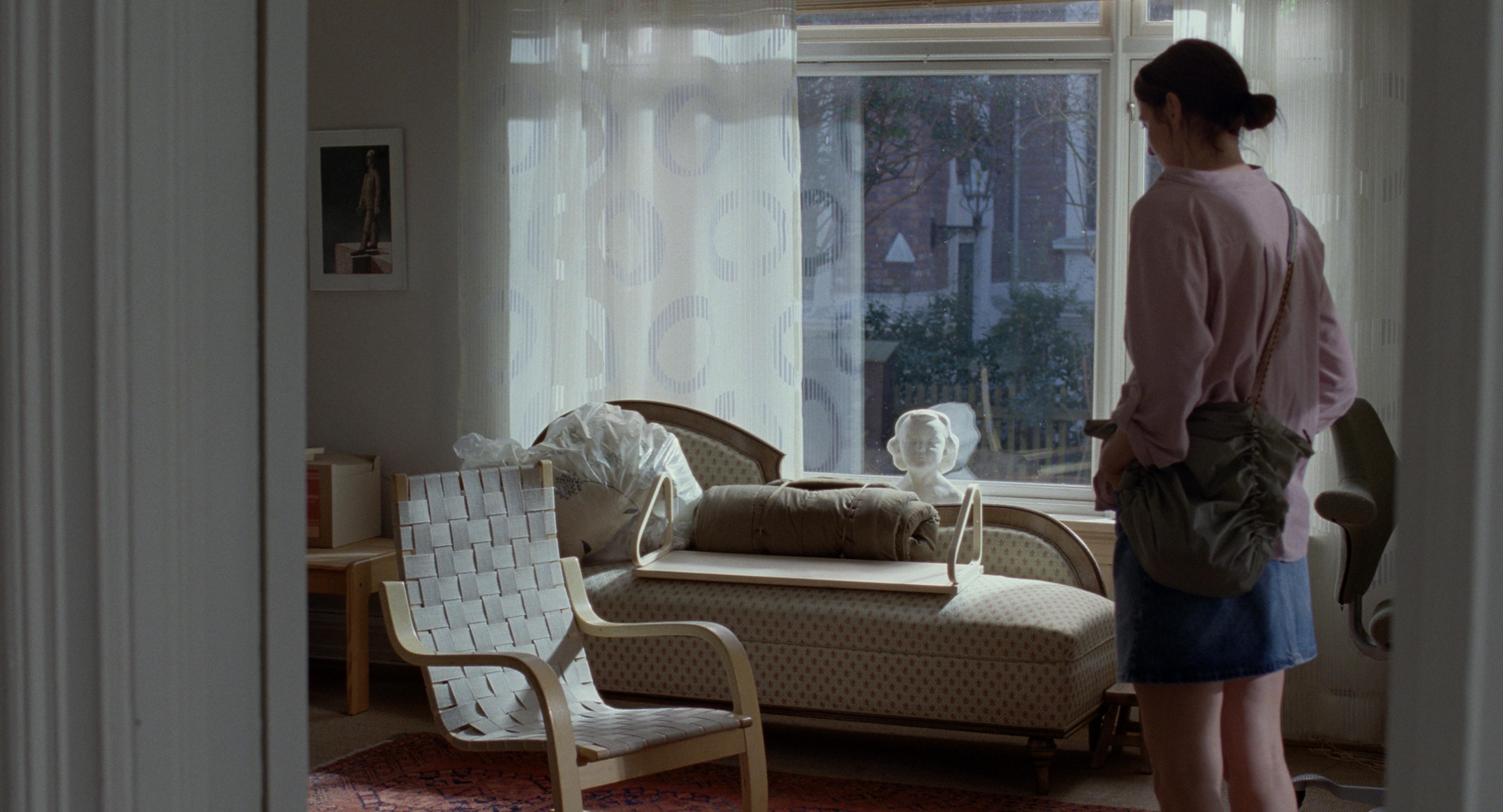
Finally, there is a chair. This connects to the chair Nora’s grandmother sits in before she walks down the corridor to the suicide room. This is replicated during the shoot: Nora sits in a chair, filmed from behind like her grandmother, before she takes an identical trajectory to her character’s death, except that this time the house is a simulacrum in a studio.
The chairs connect exactly those characters facing severe difficulty in the three generations: because Nora’s mother struggled too, it is hinted at, with depression after Gustav divorced her, and then dementia before she died. Consequently, the chair she sat in during her sessions as a psychologist is given a moment, when Nora gazes at it thoughtfully as she arrives to go through her mother’s things with Agnes. In fact, this might be the one object to which Nora attaches sentimental value. In the third generation, Nora is doubly struggling, both personally and through her character in Gustav’s script.

These three unfortunate ones are also connected via the crack that runs through the family house. It goes through the room Nora’s mother used as her office. In the earlier generation it was called the library, which Nora’s grandmother as a girl was often allowed to use spending time with her friends playing records. At the end of the first flashback, it is also visible on the wall of Nora’s room when she is preparing for the entrance exam for acting school.10 So it must be directly above the other room, also since she can listen to her mother’s sessions through the stove. One can imagine, eavesdropping on all those patients through childhood, what a treasure trove of experience for a future actress! On the other hand, might this be the reason she is reluctant to undergo therapy for her stage fright? As for the Borg house, this procession of dysfunctional people over many years will significantly add to its memories and history.
When the title of the film comes up, it is placed so that the crack in Nora’s room runs precisely through the circle of the “o”, which is also exactly the middle letter of the original title Affeksjonsverdi. Metaphorically, it is also present in the microphone wire that, very visibly, runs down Nora’s bare back as she is pulling herself together to go through with the stage performance, where her dress too is “cracked”, provisionally held together with duct tape.

Speaking of such metaphors, during Gustav’s walk-through with Rachel, there is a close shot of her with the suicide room behind her. The facts that the film lingers upon this image and the thin necklace around her throat is particularly visible here, subtly evoke the clothesline her character shall hang herself with.
The corridor from life to death
Before Nora gets up from her chair during the film shoot, in an uncanny moment she slightly turns to send the suicide room a haunted look. This echoes three looks from Gustav. Virtually his first action in the story, as he enters the Borg house to participate in the post-funeral gathering, is to gaze towards that room. Then as he is refurbishing the house in a 1986 flashback he sends it a pensive look, and finally, a desperate look after he has started drinking heavily with his film apparently doomed after Rachel’s departure. He stumbles out of the house to continue drinking outside, perhaps fearful he might take his own life in there – but the escape is only temporary. He almost ends up dead.

At various points in the film we see echoing shots of a character in the living room with the suicide room beckoning in the space behind them: Nora’s grandmother before she goes to kill herself, Rachel while Gustav is mapping out the crucial scene for her, and Nora during the shoot when checking that her character’s son is actually leaving. Visually, the room is only supposed to exert a discreet pull, and this subtlety also manifests itself in Gustav’s gazes above: it is never as simple as a shot of him looking and then a shot of what is looked at. Instead his surroundings are shown, then his look, and that’s it. And the significance of his first look will not be evident until a later viewing since we have no idea yet what the room means.

Sentimental Value is delicately obsessed with the corridor and suicide room, expressed via refined formal means. When Nora’s grandmother closes the door of the room behind her, the corridor darkens, deprived of light from the room, with the camera placed in the living room, emphasising the passage or trajectory of the corridor. When Nora’s mother too leaves the film, the corridor is in play again, as she is turning off the light in the living room, causing a similar darkening of the scene. This is shot from the opposite position, the camera placed near the suicide room. It is as if the film is gently building a bridge between the living (room) and the dead, elevating the ordinariness of the corridor into something mystical.
After Nora’s mother has turned off the light she is erased by an elegant dissolve, as if vanishing into thin air, never to be seen again in Sentimental Value. This ghostly moment adds to the feeling that not only the grandmother but she too are haunting the house, in the form of their left-behind traumas.

Later, as Agnes, a historian, is hired by Gustav to do research on her grandmother – probably as a response to Rachel’s inquiries about her to better understand a role partly based on her, maybe to put together some sort of dossier for the actress – she spends a day at the National Archive going through files of her witness accounts against her wartime torturer.7
This archive sequence subtly evokes the corridor motif, and reverses it. Now a door is not closed but opened. Like both times earlier, a faraway figure can be seen in a doorway in ghostly silhouette. But this time the situation starts in darkness and then lights are turned on – and what else than a corridor springs into being. The reversal continues: during this sequence the grandmother is brought from death to life, through her words in the files.
The archive sequence and other memorable moments
The archive section is a highlight of Sentimental Value, a master class of meticulous, inobtrusive shot-making and editing (by Trier regular Olivier Bugge Coutté), building a series of seemingly prosaic images into a quietly devastating emotional impact. It is also remarkable in its use of repetitions, with which Trier is doing his utmost to discreetly reinforce the idea that the grandmother’s fate is just one among a large number of others, casting a wider net than the Borg family for Sentimental Value.
Thus, virtually every shot until Agnes starts examining the documents includes objects replicated within the frame: rows of filing cabinets, a wall overwhelmingly packed with folders, a box with a series of index cards, a profusion of curious-looking door handles, several trolleys with documents collected for each visitor, and so on – even the row of columns in the hall as Agnes enters the building (after she too has opened a door).
The repetition also extends to human beings: in the reading room Agnes sits between two others on the same row, and in one shot the camera is placed close to the nearest one (with him just a blur in the margin) seemingly to emphasise the iteration of people along the row. Here the repetition of objects reaches an aesthetic crescendo with the green table lamps placed in exactly identical positions.

The lights that are turned on in its opening shot, as mentioned above, when an employee enters the vault, are part of the repetition strategy too, lighting up a succession of sections of the room, as if also suggesting the gradual nature of Agnes’s investigation, shedding light on her ancestor. This gradualness is also reflected in how the camera is creeping in upon the reading Agnes, with the movement even cut up into repeated instalments.
Suddenly, however, there is a very tight close-up of her, in profile, a type of shot we have not seen before in the film, the break in form marking the moment when the material, the dry reports in everyday language describing dreadful deeds, is starting to get to her.
The aftermath at home is also quietly brilliant, her mind still processing what she read, while we see the reflection from a TV screen in the window behind her – some kind of news programme, showing Norwegian Prime Minister Jonas Gahr Støre, everyday life just droning on in contrast to her devastation. The next morning is outstanding too, filmed with domestic lyricism, where she stands in the kitchen looking tenderly out at her son playing. In a great image she is shot in close-up from outside, with her face shrouded by dreamy reflections in the window pane, and then from inside the kitchen bathed in light from the window. During both stages of the aftermath, she is shot in profile but further away, as if to suggest that the impact of the archive is still felt.

The ending of “Anna”, Gustav’s World War II film in Deauville, is another highlight, with a marvellous performance by the wide-eyed, soulful Ida Atlanta Kyllingmark Giertsen. She plays Agnes playing the heroine, the one who escaped the German soldiers but likely not the trauma of survivor’s guilt, since the boy travelling with her was captured. (Her brother? Are they Jews?) Cleverly, Kasper Tuxen Andersen‘s visual texture and saturated colours here look entirely different from Trier’s own works, who by the way has hardly ever before directed a rural scene, except for a handful in Thelma.
It is also a perfect rendering of a certain type of art film, a long take where deliberate, ever more revealing camera movements change our perspective. The idyll on a field turns out to be a view from a train window, which later serves as a sort of split-screen, showing pertinent action outside after Anna has boarded. Like the Borg house, the train has windows as “eyes”. On the level of formal exercise, the scene recalls this strong aspect of Trier’s three early short films, which I wrote about here. The woman beside Anna commanding her not to attract the attention of the soldiers places the action in Norway, so Gustav’s cinematic career has not been confined to Sweden. Is the butterfly against the train window somehow connected to Gustav’s idyllic memory of such a creature, seen in a flashback? The long-take ending echoes the strategy for his new work.

Watching it for the first time in decades, to Gustav it seems to represent a lost greatness, making it even more important for him to get his new film off the ground, and more sadly resonant if he cannot. Walking along the famous boardwalk in Deauville with the names of cinema legends painted on beach huts (where we see Robert Duvall misspelled as Duval!), they possibly underline his desire to equal them but maybe also a sign his career dead like these deceased persons. His gaze lingers on a horse-driven carriage along the beach which like him harks from a bygone era.21 Maybe he yearns to drive away in it, under the otherworldly colour of the sky, captured in a stunning shot. Later, on the beach with Rachel, the intense, many-coloured parasols seem like a reference to the opening of Jacques Demy‘s The Umbrellas of Cherbourg (1964), a city on the other side of the bay from Deauville.

The dissolve intermezzo, very boldly modelled after the two heroines in Ingmar Bergman‘s Persona (1966), where the faces of Gustav and his daughters keep morphing into each other, seemed initially “too much”, too insistent, but has endured over many viewings as a hypnotically fascinating moment. Their faces surrounded by compact blackness, the situation seems to exist outside the film’s time and space, but it follows shots of Nora’s now full-blown depression – is it a vision of hers? Another Bergman connection: Borg is the family name of the hero of Wild Strawberries, one more old man reckoning with his past.
The riveting, absurd sequence when Nora’s meltdown risks ruining the premiere11 of the play is reminiscent of Gena Rowlands being overwhelmingly drunk in John Cassavetes‘s Opening Night (1977), or the heroine of Arnaud Desplechin‘s Esther Kahn (2000) refusing to go on, upset that her former lover and mentor is in the audience. The latter, by the way, is a director Trier has a lot in common with, with his multi-stranded, sprawling stories, just in a rougher, more tempestuous manner.
There are also brilliant isolated shots. When Nora finally gets on stage: the slightly low-angle long shot with her back to us, as she faces the audience before getting started, and a very sinister one just afterwards when she approaches the camera, moving from light into darkness, giving off vibes from Darren Aronofsky‘s Black Swan (2010). There is also a perfectly captured, quick comical moment of a panicky-looking Jakob, his side-eye glinting in the stage light.

The Woody Allen-like swing jazz kicking off the second flashback section is eminently fitting, since we shall soon see Nora eavesdropping on her mother’s psychologist sessions via the stove, recalling Rowlands (again!) listening to similar sessions through the ventilation system in her new apartment in Allen’s Another Woman (1988). In an elegant idea, the music continues as the flashback goes further back in time, precisely to the 1920s/30s era just after it was composed, eventually switching from non-diegetic to diegetic, coming from a record player.
This strategy is reversed as the first part of this flashback ends, with an Erik Satie piece originally coming from a radio and then fully enveloping the film, as guided by a soothing voice-over we see tenderly magical images from Gustav’s childhood – sunlight, shadows, a breathtaking shot of sun rain in slow motion on the veranda – until his mother’s suicide. The music dies before she does the deed, and Trier inserts a close-up of Gustav engulfed by blackness, apparently lost in a reverie of childhood, possibly also trying to visualise the suicide for this script.
Is he the author of the imagery around the suicide when we return to the flashback? Is the first shot of that, with her back to him, suggesting that she resists his attempt at insight? This immensely pivotal but little-seen figure in Sentimental Value is played by Vilde Søyland: Karin Borg, a doting mother with delicate features, but also Karin Irgens, the grim face on the fascinatingly enigmatic photo in her files.

Even more than the first one, in the film’s opening, this flashback section is a source of joy that easily survives repeated viewings, with the interiors of bygone eras painstakingly orchestrated by production designer Jørgen Stangebye Larsen, who also did Oslo, August 31st, and the author of this detailed article about the process. Rooms are morphing from one time period to another via elegantly seamless dissolves with a static camera, or even continuing the flow of a camera movement in the middle of a transition. (Click here for a slide show of flashback shots.) When the house is inherited by Gustav’s aunt, the hard-partying Edith (Mari Strand Ferstad), things turn more lively, but here too there is an indelibly lyrical image: Edith on the veranda, with her lesbian partner leaning dreamily against her shoulder.

The sexuality of the “happily childless” Edith also serves the plot since it leaves Gustav as the sole inheritor of the Borg house. Her life is cut short, with the sudden silence on the soundtrack speaking volumes about her life-long party being over, as we see vaguely pathetic shots of her untidy things left behind after death – and a suitably expired plant with collapsed leaves – echoing and contrasting the objects after Nora’s mother, painstakingly ordered by Agnes.
When the flashback then chronicles the early years of Gustav’s family, it manages to insert an example of childhood Nora taking care of Agnes, leading her away from a door, behind which their parents are loudly fighting. As a part of the film’s vast tapestry of contrasts, this follows immediately after a colliding image of the family in happy times glimpsed through that very door. The flashbacks of Sentimental Value are then finished off with a high-angle shot of the Borg villa almost dwarfed by the vegetation around it, fittingly pointing back to the end of the opening shot with the graveyard and its hinting at the house as a tomb, of generations that we have just witnessed.

In the main flow of the film there are numerous very fine touches: Nora left behind among the trees after Jakob has rejected her, sunlight filtered through the foliage falling on her in patterns, beautiful but also illustrating her fractured psyche; the sound of light rain against the window during Rachel’s tearful table reading; Nora lying on the floor like a fallen statue during her depression.
Renate Reinsve‘s portrayal of that state is astounding. When Agnes pays her climactic visit, Nora contains not a flicker of life, just looking helplessly at her sister, face slack and puffed up, no shame or any feeling at all, only her unfocused gaze freely admitting “I have lost it again”. This is in great contrast to the post-“Hamlet” party when, in the beginnings of depression, she is coldly stonewalling Agnes’s concerned, cautious probings.

Reinsve’s range of looks is amazing, just compare this to her ultra-glamorous real-life photo shoots. Lilleaas is no slouch either: you should absolutely see her debut film, Women in Oversized Men’s Shirts (Yngvild Sve Flikke, 2015), where she plays an emotionally clumsy, timid ingenue from the provinces, impossible to be more different than her calm, collected demeanour for Trier. Her slightly crooked front tooth helps give the character a pleasingly “imperfect”, everyday look.
Twisty turns and art versus life
The device of a scene surprisingly not turning out to be part of the real life of the characters but an artistic endeavour is old as the hills, but unusually clever and powerful in Sentimental Value. No less than three times we are tricked.
From a shot of Gustav left behind at the restaurant after having been snubbed by Nora, we go directly to an idyllic shot of field in the countryside, where a wartime situation plays out, of children fleeing German soldiers. Since we have already observed tentacles going back into history in the first flashback montage, we assume this is another flashback. It turns out to be the ending of Gustav’s film “Anna”, being screened in Deauville.
Later we are led to believe that Nora is having a breakdown at home, but after a long take framing her tightly, a second, much wider shot reveals that it is part of a rehearsal of a play, with people from the company watching her. We have just seen her dejectedly walking home from a disastrous clash with Gustav at the birthday party, so we are focussing on her mood, not necessarily noticing that the door she came through seems too rough to fit her apartment, and that she wears different clothes. Her crying seems to go far beyond what might be required of acting, however, and we intuit that her act has turned into a real breakdown. Reinsve’s tears are unsettlingly convincing and go on for a long time, making one think of her tour-de-force, instant classic scene in Armand (Halfdan Ullmann Tøndel, 2024), featuring a (much longer) fit of convulsive laughter.
The rehearsal marks the start of her downward spiral into depression, and before the premiere of what should be her big moment playing Hamlet, she sits in her dressing room in a totally flatline mood, in great contrast to the hysteria before the previous production. Then she walks on stage like an automaton, after sending a blank, disinterested look towards her nemesis, the apprehensive stage manager. At the party afterwards, her most sincere words, among all the congratulations, are “we got through it”. The fact that the film skips her performance entirely after she has got on stage, instead cutting directly to the party, suggests that her presence there is just an act as well.

Then there is the third occasion. We have already been thrown off balance by witnessing the beloved house being refurbished, and even painted white – and the exterior shot of it is outright shocking, the mystery of the villa, seen from the same vantage point as at the film’s start, now brutally erased. Then we are disoriented, because we are suddenly in the house after all, and except for the furniture, it looks the same. Is this just another flashback?20 Nora is preparing food for Erik, which is odd, but maybe she is just taking care of him while his parents are away or something – or might the whole family have taken over the house now, living there side by side? (Wild idea: has the previous action of the film all been in Nora’s mind and Erik is her real son?!) There is some blue material outside the windows, but at the early stages they are very peripheral to the action and not really that noticeable, since on a first viewing we concentrate on characters and what they are doing.
When it becomes obvious that Nora is preparing to hang herself, there is a sinking feeling that life is going to imitate the art of Gustav’s script and the past of the grandmother. Granted, this is very strange after the life-affirming scene with her sister, but there are so many other oddities in play here that we concentrate on the present. Also, has she not attempted suicide before, and have there not been a great many surprising upheavals off-screen already, so Nora’s volatile psyche could have suffered a recent setback? When she is interrupted by the boy knocking on the veranda door, however, this author realised that, like with “Anna” in Deauville, we are inside Gustav’s new film.
On the veranda we now see an enormous tarpaulin-like sheet in the background, which is odd, but might there be some restoration work on the building opposite? On a first viewing we really have no clear idea of the Borg house’s surroundings. Afterwards she walks through the all-important corridor and shuts the door behind her. Gustav’s film was supposed to end here, but in another twist, there is a new shot after the long take. Now we are in the suicide room with her, where she is standing still, thinking. Is this a change in the script, an added final shot to raise the possibility that she might change her mind, with the prospect of a happier ending? (But when we soon get a wider view, there seems to be no camera around.)
With Nora standing there, someone off-screen says “cut”, and it turns out to be Gustav. The whole thing was not the film itself, but occurred during the making of it. The pause is probably due to Gustav being lost in thought and/or giving Nora an opportunity to contemplate the situation, and she is just in stand-by until her action in the long take is officially terminated.
There are many subtle changes compared to what Gustav tells Rachel during the walk-through, reflecting adjustments that will often happen to a script, but they also might be intended to throw us slightly off. Erik knocks on the veranda door rather than opening it. He returns to fetch his phone not a flag; obviously it is no longer the 17th of May, Norway’s national day. With her background as a World War II prisoner, killing herself on that day would have had great resonance for the aspect of the heroine that is based on Nora’s grandmother. Is this an indication that this aspect is now less prominent in the script? It seems the boy is leaving for school – echoing how Nora in childhood made sure Agnes got there – and the father who was supposed to meet the boy on the 17th of May, according to Gustav to Rachel, might be out of the picture, reflecting how Gustav disappeared from Nora’s life.
Furthermore, after the suicide room door is shut, the camera is closing in rather than receding. She is using a chair for the hanging, not the IKEA stool. We hear no sound of it falling behind the door. Neither did we hear the sound of the gate closing behind the boy, which was supposed to come from off-screen with the camera resting on the mother’s face. The reason for the lack of these sounds is that such effects are not recorded on the set but added afterwards, so this is another clue that what we see is a film shoot.

Trier shot of all of the flashbacks with this artificial house to make it easier to change the interiors for each time plane, as detailed in his production designer’s article. An interesting thing about Gustav’s set is that instead of Trier’s use of giant LED screens to project imagery through the windows in real-time, the determinedly old-school Gustav Borg has gone for the bluescreen option of adding window views afterwards, thus the blue material in the windows. Probably this method is also used so Trier can provide further clues that Nora’s long take happens on a set.
Thinking back on Nora’s idea of the house as a living being, with windows as eyes, it is now blinded. This emphasises the artificiality of the copy. The real one having absorbed the memories and history of its inhabitants is an intangible quality that is not transferable.
What does the studio at the finale of Sentimental Value entail? “At the end, the house becomes a film set. Cinema becomes home.” These words from a Facebook posting after the Cannes screening, by Oksana Chefranova, a film scholar from Yale University, strikingly articulate the essence of Gustav Borg, who said in Deauville that cast and crew during a shoot are “family” to him. As regards Nora, her yearning for a home may be beyond reach. The strain of her unselfish caregiver role for Agnes in childhood to preserve her little sister’s sense of normality could have fundamentally destabilised her own ability to form lasting relationships. Nevertheless, she is able to process her real emotions via her artificial character, and the positive longing for a home and the negative pull towards suicidal depression are fruitfully intertwined on this studio set.
Furthermore, might the studio setting be a slight contrivance from Trier’s side to be able to emphasise the laboratory aspect of cinema – a safe place for exploring difficult emotions? One thinks about the famous ending of Solaris (Andrei Tarkovsky, 1972), where the camera pulls back to reveal that a scene we thought happened on Earth actually was on an artificial island created by an intelligent being on a far-away planet, an entity that has been working with the memories of the human visitors to help them come to terms with their traumas. The reveal of the artificial studio setting in Sentimental Value would be something similar and much more striking as a laboratory, than if the reveal that it was a film shoot happened at the real house.
The hero of Solaris embraced his father on the artificial island, a parent-child relation that mirrors Trier’s film, and the presence of a house there makes the parallel even more important, given the Borg villa’s central role for Trier. Nora’s musings about the house as a living being is also interesting since its counterpart on Solaris is also an object, namely the planet’s ocean.

On a continuity level, the studio finale is the vaguest aspect of the film. Was the Borg house sold, and refurbished, before Gustav started shooting at all, perhaps to secure the financing of it, so that he had to give up the idea of shooting it there?20 Or has the studio set been created only to capture the long take, which for technical/spatial reasons might be impossible to do in the house? That seems awfully expensive just to capture four minutes of film.
The most important reason for the vagueness is probably that it would be impossible to trick us about the film shoot if we are already clued in by information about how Gustav’s production is proceeding. It must come out of the blue for the ending to work – a finale that is part and parcel of a general strategy of unpredictability for Sentimental Value.
Unpredictability and contrasts
Some other, semi-major twists are Gustav turning up with Rachel Kemp at the Borg house, and Jakob’s sudden break-up with Nora. These are developments we are deliberately kept in the dark about – for example the exact events leading to Gustav and Rachel teaming up following the deep rapport established in Deauville – because the film wants us to be with Nora and share her surprise.

All of these twists are part of a larger pattern of contrasts and tonal shifts, as if mirroring Nora’s volatile psyche, that makes Sentimental Value the most unpredictable in Trier’s work.
In the second flashback the idyll and comforting music suddenly shift into suicide and silence. Then the expected sound of the chair falling behind the closed door of the suicide room, as described in Gustav’s script, is substituted with a drumbeat from a rock song as Edith’s story starts. The rousing soundtrack of her life is cut short by yet another silence, as we jump to the aftermath of her death. These stillnesses acquire extra weight since Nora’s school essay imagined that the house liked silence even less than the commotion of quarrels. The brevity of the compressed lives and events of both flashback sections chimes in with the voice-over musings about the house continually collapsing due to the crack, just in ultra-slow-motion, and that its inhabitants’ lives constituted just a small second during this fall.

The action is regularly paused by a few seconds of black screen and virtually all of them signal a tonal shift. From the ecstasy of warm applause in the theatre, to a scene of winter and a somber funeral gathering. From a disappointed Gustav in the enclosed space of the restaurant, to a sun-drenched field out in the country. From the nostalgia of a flashback to hypermodern, glaring celebrity hysteria as Rachel Kemp arrives in Norway, with harsh pop from New Order. From Nora’s bitter crying during the rehearsal, to the upbeat glitter of Roxy Music’s “Same Old Scene” as Gustav is driving to Sweden to see his old cinematographer. The latter case is reminiscent of the sudden break in Louder Than Bombs, its sobriety ripped apart by the gravity-defying view of cheerleaders flying through the air, to the sound of dissonant, writhing electronic music.

Sometimes the shifts are accompanied by a bridging element. From Nora as an eager youth preparing for acting school in her room to lively music, the film jumps to the current time plane, with Nora alone in another confined space, her dressing room, but the music is substituted by yet another silence, her wish to be an actress now fulfilled, but there is no joy, only paralysing panic.12 From the exhausted old Gustav collapsing unto a deckchair in Deauville, to a laughing couple full of vitality lying down too, in a bed. In reverse: from a warm embrace between the sisters in bed, to Gustav lying down too, in the cold autumn, unconscious on the ground, from drinking and a heart problem.
There are also some more subtle contrasts, for example the suicide room used as something as prosaic as a temporary cloak room during the funeral gathering. The same happens during one of Edith’s parties, and that comes in the shot immediately after the suicide of Nora’s grandmother.
The film is also saying something about, or rather lets us experience, the contrast between stage and movie productions. At the early stage play, an ecstatic Nora is enjoying thunderous applause, the immediate gratification and reward, in the starkest possible contrast with yet another silence, after the long take is finished where she has to make do with a glance and a tiny smile. Far from ecstatic, on the film set the mood is entirely businesslike, with the crew soon starting to fan out doing various tasks, and Sentimental Value ends with a long shot giving us a good view of this – now emphasising similarity, between the collective effort of this crew and the backstage personnel who made the stage production possible, as pointed out by Anne Gjelsvik.

The exuberant joy, from audience and actors alike, after the play is also in contrast to the dark material, based as it is on the famous 16th-century witch hunt of the Norwegian Anne Pedersdotter who was burnt at the stake – the same case inspired the Carl Theodor Dreyer masterpiece Day of Wrath (1943)! – and the fatal end of Nora’s character here can be said to be harbinger of her fate in Gustav’s script. Not only that, but the fact that the play is just make-believe and the witch rises from the dead to receive the applause, foreshadows Nora’s suicide in the ending actually being part of Gustav’s production. The film’s gradually emerging importance of having a home is reflected in Nora’s furious line on stage: “I let your children into my home!”
Another (very) subtle foreshadowing, this time of the fact that the long take turns out to be created in a studio, is the brief high-angle shot of the stage manager outside Nora’s dressing room. Here it is made clear, almost as if it were a deliberately artificial device à la Brian De Palma, that the whole area has no ceiling and simply consists of a series of walls inside a much larger hall, like the film set. From this shot, one might wonder if the backstage theatre stuff was shot in a studio too, but this is actually how it looks like at Oslo’s National Theatre, possibly to facilitate quick changes to the dressing room area.
Rhymes, echoes and intertwinings
In a film casting long lines back into history and previous generations, it is fitting that rhymes and echoes play a major part in its structure. On my first viewings of Sentimental Value, I was, for example, constantly mixing up Nora’s grandmother and mother – and the film might well be designed to have such an effect, because the mother too suffered tragedies. Also, the experiences of her grandmother and Nora herself are intertwined in the heroine of Gustav’s script. Like Nora, Edith too used the stove for eavesdropping on the floor below. Time planes are ingeniously interwoven during the funeral gathering when Nora suddenly hears Gustav’s voice via the stove, as if it literally comes out of the past, when he was part of the home and she is a child again.
The family constellation of sisters in the current time plane has its counterpart in Edith and Nora’s grandmother, and they too are very different personalities. In both cases, the eldest were the suicidal ones. In the past, it was the younger sister, Edith, who was the rebel, however, but in both generations it was the older sister who at a point took responsibility: the grandmother as a resistance fighter and a parent, and Nora as a child protecting and caring for Agnes. There is even more sisterhood: the heroine of Gustav’s script has a sister, and Trier’s own small children, who appear briefly in the film, are two girls.

Clothing seems to play a role in the film, with the topwear of characters often clashing, subtly signalling something. (Costumes are by Trier regular Ellen Dæhli Ystehede.) In the scene where Jakob breaks up with Nora, the colours of their tops are markedly incompatible. When Rachel arrives at the Borg house for the first time, she and Gustav are almost comical in their perfect alignment, both in black and with “film star” sunglasses, as if her glamour has already rubbed off on him. But when they start walking through the all-important long take, she is in a white top, as if signalling her basic unsuitability.
There is also another sort of clash going on here, because he seems intent on establishing some kind of domination, for later use perhaps, deliberately unnerving her about the morbidity of recreating his mother’s suicide. During the first table reading where she is flailing, the black-white clash is present again. Only when she has dyed her hair and applied a Norwegian accent, in a later reading, she wears black like him, but now she is totally out of it. In the Nora-Rachel meeting in the theatre, the black-white constellation recurs.19

Hair is harmony, however, for the sisters. Except for some brief appearances, Agnes has always her hair tied up. But in her last scene, the moving reconciliation scene with Nora, her long hair is flowing freely – like Nora’s in the scene and, not least, like their emotions. During a key exchange both are resting on their elbows on the bed, creating further harmony. In Agnes’s first scene, during the post-funeral gathering, Nora’s hair is up too, creating here as well a sense of alignment, helped by their black clothes.
It is notable that when Nora’s hair is down in the film, it is almost always in scenes with Gustav, at its most essential during the birthday party for Agnes’s son, where Nora’s plan seems to be to seduce her father. She makes sure to have a calculated one-on-one entrance opposite him and appears at her most stunningly beautiful, playing on his constantly expressed admiration of beauty, and she is definitely more alluring than her replacement Rachel Kemp. She looks not unlike Monica Bellucci here13, perhaps in a meta play on the Italian actress’ part in one of the DVDs that Gustav gives to the boy. The seduction seems to work, for in a priceless moment out smoking together afterwards he sends her an almost lecherous grin.14

Another favourite moment in Sentimental Value occurs when Nora’s mother Sissel (Ida Marianne Vassbotn Klasson), in her one moment of agency in the film, in a calm, warm voice tells her flustered patient: “We have been here before”. Her words exactly replicate Nora’s theatre director in the dressing room door as he tries to talk her down from her catastrophic stage fright. (In both cases there is little effect.)
This is perhaps not a coincidence, because Trier constantly shows how a director has a sort-of-psychologist role towards the actors. Not only to calm them down: it is notable that every time Rachel has questions about the film – for example, why her character commits suicide – Gustav deflects them back to her, asking what her thoughts and interpretations are, much in the way a psychologist will encourage the patient to actively participate in the analysis.
When Nora gets overwhelmed she is fleeing. This happens three times in the stage fright sequence: refusing to leave the dressing room; acting on a whim to disappear with Jakob behind the scenes to make him help her snap out of it; facing her nemesis, the stage manager, she loses all self control and runs off far up into the building in sheer panic. So, when Gustav arrives at the house with Rachel Kemp in tow and she realises her father has managed to get his film off the ground without her, off she runs again.
As if a frightened child, tellingly replicating the route we saw her take as a little girl in the first flashback, she gallops out the back door and through the hole in the fence, to avoid being seen by the incoming party. Ironically, she is clutching the red vase she did not really want, but picked anyway to jokingly spite Agnes, who expressed interest in it, and has it now only because she grasped it to avoid it falling when she brushed past – an object without meaning but prominent in the scene, illustrating the irrationality of her behaviour but also the misplaced obsessiveness about her animosity towards Gustav. One might also say that as a memento of her, it symbolises Nora’s mother, whom she now tries to save from the invading father who hurt her so much.

In essence but in miniature, another flight happens when she abruptly leaves Agnes’s apartment after her husband has started wondering from whom their little boy has picked up his unusual “I see you” statement. She seems acutely embarrassed that they might soon conclude, correctly judging from Nora’s expression, that it is due to her influence. In the cute scene just before, where Nora lies on the bed next to the lovable boy, there is an edge to her exuberant laughter, a fraction of something mechanical and even desperate in her elation, somehow accentuated by a curious, sharp line by the corner of her eye. The entire sequence is brilliantly acted by Reinsve, including her repeated “I am okay” with a odd, brief laugh on her way out. It is this situation that makes Agnes start to worry about Nora’s mental well-being. It is ironic that Nora, who on some level obviously covets having Erik as her own child, actually is his mother during Gustav’s film shoot.
Roundabout intertwinings
There is a beautiful, subtle echo involving Agnes: after she has been to the archive, and when she is finishing Gustav’s script in bed. In each case the setting is studiously everyday and domestic, it is late in the day, her husband is present but she is in a world of her own, there is a window behind them, and the camera is gently closing in. In the first case she cannot let go of the upsetting documents about her grandmother’s wartime imprisonment. In the second one she reads another form of documentation, this too yielding insight into a character, driving home to her that Gustav is a wholly different person in his art. The script turns out to be totally different than expected, and, as she tells Nora in a very moving, slightly childish line delivery, “really great”.
In a nice touch, in the bedroom window behind Agnes we see the headlights of a car passing by, and in the next scene the lights of a car announce the arrival of Rachel at Gustav’s house.15 Probably not the same car, but it is a very elegant way of naturally connecting the scenes, in an invisible flow, not only bridging the locations but the essence: Agnes is introduced to the script and Rachel comes to quit the script – the latter’s act a milder form of Agnes’s rebellion against Gustav earlier that day. Also, Rachel’s entrance to her last scene echoes Gustav’s own arrival by car in his first scene, but now the occasion is another burial, that of his film project. It will nearly cause the death of himself as well.

On the whole, there is a curious set of roundabout intertwinings going on here. Agnes is overwhelmed by the archive material like Rachel was by the key scene in the script, in two scenes closely following each other. Later, Agnes too is bowled over by the script. When the depressed Nora starts to read aloud the same important scene, it is in a toneless voice as if it was one of the dry documents from Agnes’s archive visit. During this scene, moved by the effect the script eventually has on Nora, Agnes dries her tears like she did decades ago, when playing Anna on the train. In that film, her companion, possibly the brother, was left behind. But this time around, Agnes saves her sibling, Nora, by bringing her the gift of Gustav’s script.
This is not all, however. In Deauville there is a close-up of Rachel in the movie theatre, as if she is mirroring herself in the long close-up of Anna that ends the film. Like Anna/Agnes in the film, Rachel too is shedding tears and drying them off. There is a close-up of Gustav as well, immediately after “Anna” is over, looking transfixed, having lost himself completely in the sight of his daughter and his film. Then at the end of the Deauville beach sequence the next morning, in a flourish of old-school gallantry Gustav arranges for the horse-driven carriage to take Rachel back to the hotel. Here the director is staging a get-away for Rachel that closely mirrors the ending of «Anna». Like the girl escaped on a train from two German soldiers chasing her, another vehicle is now whisking Rachel away from the two minders from her management, who run after her like the soldiers did.
So art and life get intertwined but also family: Rachel will become Gustav’s substitute daughter as the heroine of his new film – in the sense that Rachel will become the most important person in his life – so the carriage incident can be said to foreshadow this development. In the beach re-enactment, Rachel is replacing Agnes, and soon she will replace Nora in Gustav’s film, all the while expressing the admiration and respect he is unable to get from his own daughter.

There are more foreshadowings. The get-away from her minders reflects how she may escape from the world of commercial cinema to Gustav’s arena of art cinema, and through Rachel’s participation Gustav can get out of his problems raising money for his film. The throw-away moment when the bodyguard stops him from approaching Rachel’s table in the restaurant and the film star’s command lets him through is prophetic of how she will be his ticket back to the big time.
Echoes of the score
The Deauville escape is one of the most delightful moments in Sentimental Value, accompanied by an elegiac, wistful, uplifting theme, the score too joining in to play a role in the film’s rhymes and echoes. This is a moment of blissful harmony and joy between Gustav and Rachel, and in a work where the original score plays a subtler role in-between the much more overt pre-existing music, it is one of the joys of film analysis to discover that this theme reoccurs a surprising amount of times, in fact becoming the main one.
It plays as Gustav and Nora are smoking and smiling together outside during the birthday party, when Nora for a brief while thinks a new understanding and harmony with her father has arisen. It reappears at the end of the second flashback as we witness the uplifting story of Gustav’s family being formed, with wife, Nora and Agnes, and also keeps soldiering on during its disintegration into quarrels and divorce. The fourth time occurs when Agnes is reading Gustav’s script, but now in a more thoughtful and somber mode, as she enters, to her surprise, into a harmonious communion with Gustav’s soul through his writing. With her inclusion the theme has now touched the whole family – even her mother in the flashback – but her domestic environment could not be more different than the romanticism of the French beach.
But there is a fifth time, as a closely related but much slower, more fragile and tender theme communicates Agnes’s mood at the archive when the material starts to get to her in earnest. Here, across more than half a century, Agnes experiences an intense rapport with her ancestor, which explains the connection with the harmony main theme.

The original score is by Hania Rani, who is behind almost all of the stand-alone piano music, as well as the more orchestral harmony theme and the final end title music. The mournful theme that starts as Nora is left behind among the trees and continues while she walks to the birthday party is repeated after Rachel has left Gustav – Jakob had just before broken up with Nora, and Rachel represents another break-up, with Gustav’s production. In the last case, sound design (by the ubiquitous Gisle Tveito) joins in, recurring barks of dogs in the distance having been elegantly woven into the music.
The raspy depression theme that begins during the “Hamlet” party, expressing Nora’s loneliness and inability to feel joy among the crowd, returns just afterwards at home where she falls into a depressive stupor, ending with her calling in sick, basically giving up on the prestigious role, and continues over the “Persona dissolves”. It also strikes down Gustav after Rachel has left the film as he tries to drink himself into oblivion, augmented by the mournful howl of a wind instrument – recalling the train horn at the very end of «Anna», as if the end of his own life is now imminent.
The thoughtful, grave piano that starts towards the end of the only scene that Nora and Rachel have together, at the theatre, and continues over the conversation between Gustav and his faithful producer Michael (Jesper Christensen) is another musical highlight – two situations drenched in doubt.

The only piece of pre-existing music playing a structural part is “Dancing Girl” by Terry Callier, which ties the opening to a passage near the end, both exploring the Borg house. What starts out as cheerful soul folk music takes on a darker, almost threatening undertone the more the house is subjected to the prowling camera movements, before the voice-over of the first flashback section begins. It returns as the dreadful results of the sterile refurbishing of the villa are forensically delineated before us. The last shot, of the corridor and suicide room door, which is ajar, is somewhat ambiguous, however, as if some remnant of its soul might have survived, not necessarily in a positive way.
There is also an echo in cinematic form: the inventive and hypnotic camera movements outside the house of the opening have now moved inside, but their creativity has yielded to coldly geometrical motions, either forwards or backwards. The only comfort among all the devastation is that the villa will live on in its old glory in Gustav’s film.
The three mirrors, and a fourth one
In addition to doors, chairs and beds, there is another object important to Sentimental Value. The film dwells upon Rachel seen in a mirror as she is investigating Nora online. This is the point where it fully sinks in that she has coloured and restyled her hair to resemble Nora (at Gustav’s request, faintly recalling Vertigo), and the use of the mirror seems to subtly underline Rachel’s attempt to merge with Nora. The next shot is not via the mirror, but its presence is carried forward since her phone forms an identical rectangular shape, and it is as if she is mirroring herself in the photos of Nora. Also, her face is illuminated by the phone, as if the pictures of a beaming and powerful Nora is a force radiating from the screen.
Here Rachel seems only to feel her inadequacies for a role Gustav specially wrote for Nora – “only you can play the role” – and the later Rachel-Nora scene in the empty theatre only reinforces their difference in demeanour, and the location itself signals Nora’s vastly superior acting experience.

The second occurrence is more emphatic: the scene where Agnes starts to read Gustav’s script is carefully set up to show her in a mirror in a longish take when reading, as if she is mirroring herself in his mind, recognising him as a fellow human being rather than the cold manipulator just a few hours earlier, and realising his ability to transcend his limitations as a human being through his art.
During the almost four-minute long take that is supposed to end Gustav’s film, part of it is covered via a mirror. In it we see Nora traversing the corridor to the suicide room of her grandmother, her action mirroring her ancestor, her role in Gustav’s film also mirroring her own suicide attempt. It is also fitting that a mirror that has dutifully hung in the Borg house for decades (here) should be honoured with a role, making it another of the “eyes” of the house.

But there is also a fourth, meta(phorical) mirror. The fact that both Joachim Trier‘s and Gustav Borg’s climactic long takes are one and the same, seen through the same camera, acutely heightens the mirroring between them. It is after all Trier who made the scene from “Anna” – and Gustav is in a way reciprocating by directing the long take, where Trier is just following along. Gustav having written the role for Nora reflects how Trier’s The Worst Person in the World was written especially for Reinsve, her first important film role like it would be for Nora.
When Gustav’s producer puts the theme of suicide in context with the director’s oeuvre as a recurring element but much purer and clearer now, this has a loud autobiographical resonance for Trier’s work as well. Is Sentimental Value meant to do the double whammy of putting to rest not only Gustav’s but also Trier’s own artistic preoccupation with suicide?
Furthermore, Trier has stated that it was urgently necessary for him to make Sentimental Value, a reflection of his own recently established family life and appreciation of having a home, after having devoted most of his life to cinema. This urge is reflected in Gustav Borg’s obsessive quest to make his film, whose name can be briefly glimpsed on the script lying in the Borg house kitchen, and the Swedish “Hemlängtan” translates as “Homelonging” or “Homesickness”, the latter with a fitting double meaning. An aging man, he is drawn back to his childhood in the Borg house, which was so highly formative to him as an artist, to come to terms with it, as well as his mother and Nora. Also Nora’s yearning for a home and a more settled life reflects Trier’s own late development. The producer’s words to Gustav that “so it took all these years to get there” can be related both to the late appreciation of a home and the process of working their way to culminate the suicide theme.
The nature of the ending
The film’s opening and closing shots too mirror each other. Both are high-angle images surveying a large area, but where the city and graveyard were devoid of people, the studio is teeming with life.16
There has been some discussion about how strong Gustav is as a filmmaker. The fact that the house turns out not to be real but a studio simulation might suggest an undermining of the Borg family healing process as something illusory, so perhaps his new script is not that good either? The ending of “Anna” in Deauville seems stunning, however, and to be given a retrospective at a venerated festival is a sign of high regard.17
As for the script there are many indicators of its excellence. Not only is his producer unflinching in his encouragement in a period of doubt for Gustav, he also shows his respect for his work by making the speech about what the suicide theme means to Gustav. His former cinematographer is so impressed that he is willing to come out of retirement. Most important, however, is the profound effect it has on both daughters. Somehow, via his intense musings about his mother’s suicide and an artist’s insight into the human mind in turmoil, he has crafted a character that they can easily identify with, as if he had been there right with them during Nora’s most difficult times.
On the other end of the importance scale, there is the tiny, playful reference to the legendary writer from Reprise (2006), the reclusive Sten Egil Dahl, a wordplay on Stendhal, behind Gustav on the sign on his seat in the restaurant – is it mocking him or equating him with another master?

Although on the face of it ambiguous – and the sudden appearance of the once rejected cinematographer, now beamingly on board again, gives it an aspect of fairy-tale wish fulfilment – the ending of Sentimental Value seems rather meaningless without assuming it is basically a happy one. Are we to believe that the profound union between the sisters is somehow built on an illusion, just an irony based on them going overboard about the script?
Also, Nora’s relieved outburst of a smile after the take is over seems a solid signal, not least because it comes as a response, after Gustav at first seems lost in his own ponderings, to his shy look towards her and his almost invisible, thin-lipped smile, which is similar to his reaction to Rachel’s emotional table reading that made such an impact on him. Among the two of them, having such trouble expressing deep feelings except through their art, is this his long-distance way of repeating Agnes’s “I love you”? Their silent communion seems to acknowledge the fact that they have helped each other process their traumas. Before calling “cut”, Gustav might have been thinking about his dead mother, but now he beholds his living daughter, who has transcended the death in the script.

The reconciliation between people also extends to art forms, in the words of Jørgen Stangebye Larsen in his article:
In the end, the set of the house … was built on a 60cm-high platform. Practically, this allowed us to extend the view to the LED screens without revealing the studio floor. But it also gave the space the quality of a stage. In the last shot, Gustav and Nora reconcile there: Gustav, who had never shown much interest in or respect for Nora’s theatre and television work, now steps up onto her stage and stands with her. What began as a technical solution for virtual production became, in the end, a poetic gesture – a stage for reconciliation.
Apart from some shouted commands among the crew, the last word of the film is Gustav’s “perfect” – as if responding to Nora’s statement in the restaurant, a long time ago, that she is very interested in talking to him about what he thinks about her art. The rest of his response is beyond words. Another resonance of finality is the fact that this might well be Gustav’s last film, and if shot in sequence, the last scene of his directorial life. How wonderful if that would also include a true reconciliation with Nora.
It is also fitting that Gustav’s last act in the film is embracing his grandson, who played himself as the boy who “did not get it” while having his last look at his mother alive. As the generations of the Borg family keep marching on, the boy is also a possible successor as a filmmaker, like Joachim Trier followed in the footsteps of his grandfather Erik Løchen. Is it a coincidence that the boy is called Erik?
During the very last seconds before Sentimental Value fades to black for good, in the long shot of people moving about, among all the activity a crew member can be discerned opening the door of the suicide room, walk through it and close the door behind him again.
After it has served in the healing process of the Borg family, the door that has exerted such a morbid pull all through the film now has become like any other, and can be unceremoniously operated. There is no trauma any more.

Enclosures and footnotes
The film is almost irritatingly vague about when exactly Nora lost her father, but it is likely not long after she was twelve – he approved of her school essay portraying the house as a living being that she wrote at that age, so he must still have been around then.18 It is also unclear about how much contact there has been afterwards. At the restaurant a furious Nora commands Gustav to stop making drunken phone calls – is this only in the (probably brief) time since they met at the post-funeral gathering, or has it been going on for some time? He has seen her act in the theatre at least once, in “Medea”, because it was noticed that he left during the intermission. He seems to have seen Agnes’s son before, but a very long time ago. But Agnes has worked for him as a researcher sometimes, he says to Rachel – or is it just an imprecise way of saying that she is hired for the new film? Or was it for the documentary he recently made?
Anyway, Agnes seems to have had some contact, and on Nora’s part it is likely that some of the reason for the lack of contact is that she has been actively avoiding him. Agnes has not told Nora about the possibility of his turning up at the post-funeral gathering – was she afraid that then Nora would not be there? Also, afterwards, Nora accuses Agnes of never daring to speak to Gustav about serious matters, a meaningless remark unless there had been a reasonable amount of contact as adults.
There has been some interior changes to the house since Oslo, August 31st:


A slideshow of various shots from the flashbacks. Notice how some of the rooms (the main bedroom and the psychologist office / library) are repeated over several time planes, from (nearly) the same camera position.


Footnotes:
1. The house has also been described as built in dragon style, a variation of Swiss Chalet Style.
2. Gustav must be born in 1951 since his mother committed suicide in 1958 and he was seven. Still he says he was 55 when he did his last film, which was fifteen years ago, according to the Q&A in Deauville. That would put Sentimental Value in 2021, but there is no pandemic going on. Probably he is simply inaccurate about his age. (Nora is born in 1987 – the same year as Reinsve, and Skarsgård is as old as his character too – and her grandmother in 1922, according to the archive documents.)
3. The mother’s dementia seems to be an autobiographical element, see for example this interview.
4. The idea of the Borg house as a living entity with “eyes” is playfully alluded to in the first flashback, when children are playing and a character holds black circles against a window to represent eyes, and there is drawing of a smiling mouth attached to the door below.
5. The film’s Wikipedia entry as of 21 November 2025 [and for several weeks into the US release] falsely claimed that the sisters are estranged and that they have a strained relationship. If the script at a time reflected this, however, the brief scene – about the only thing in the film ringing a false note – where they speak together as if they had never before really talked about Nora’s acting profession, could be a remnant of that.
6. This is an alternate reality version of the Deauville festival, which takes place in September, while the timeline of Sentimental Value puts it in early summer. Neither does a Gustav Borg retrospective fit its devotion to American cinema.
7. The names of the locations of their work, the National Archive and the National Theatre, nicely connect the sisters.
8. Agnes’s surname, Borg-Pettersen, seems designed to join the artistic Borg with something more mundane.
9. As a mark of how much Gustav has come to mean for the boy, when Erik comes home he first hugs his grandfather, then his mother. A great moment in the film and easily recognisable for parents, is how Agnes blinks back tears after the quarrel, and says “hi” to him in a fake, relaxed manner. When Gustav leaves, basically thrown out by Agnes, the camera pans back from the door to Agnes and the boy, an unusual movement in the film, possibly a sad reminder of the swish pan film trick Gustav taught the boy in the park during happier times.
10. The text she is preparing is The Seagull by Chekov, the part of Nina, which resembles Nora’s name.
11. It is never explicitly stated, but Nora’s performance is likely a premiere since the director is present in the audience.
12. Nora is panting and leaning backwards on a bench as if she is about to give birth but the baby refuses to come out.
13. Other likenesses: In a prone position in the hospital Skarsgård looks startlingly similar to John Gielgud! And Anders Danielsen Lie looks like John Cassavetes in a couple of shots with Reinsve when he breaks up with her after the actors’ picnic.
14. Nora’s behaviour towards Gustav echoes her “flirting” with Erik when she is tucking him in.
15. In a telling deglamourisation of the film star in the process of working on a serious film, she opens the door of the car herself now, while it was opened by a driver when she first arrived at the Borg house.
16. Like the first shot’s movement from life to death outside is transferred to the corridor inside the house, what was earlier in the film exterior shots looking at the house has become an interior shot.
17. We never get any definite answer about how big a part money plays in Gustav’s approach to actresses. How much has Nora’s success in a recent TV series and name recognition for her stage work meant for Gustav approaching her for the part, as his only way to achieve a comeback? The question becomes even more pertinent with Hollywood star Rachel Kemp. Probably there is a mixture. As the film progresses, the script seems indeed to be written especially for Nora, and he appreciated Rachel’s yearning in Deauville to do artistically meaningful work. Like Nora says, he must have seen something worthwhile in the star, at least something that can be moulded. Even though he is obsessed about making the film, he does not seem detached from reality or outright stupid.
18. Is this why Gustav at the birthday party encourages Nora to write her own material? It is also amusing that Nora got the grade “6” for the essay, which is also the highest grade in Norway’s widely used film rating scale, and her previous film from Trier, The Worst Person in the World, got a lot of those.
19. The title of the film is shown against a white wall and then against a black screen.
20. The film’s Wikipedia plot summary claims the final refurbishment of the house is a flash-forward, but there is no definite indicator that is the case.
21. To be more specific, this looks like someone out training the animal for a form of horse racing.
22. A great example of healing through experiencing art is the mother and daughter attending the opera at the end of Margaret (Kenneth Lonergan, 2011).