Ghosts of the Present: Spectral Echoes and Utopian Ruins at the Berlinale
Gabrielė Liepa (b. 1993) is a Berlin-based Lithuanian filmmaker, writer, performer and critic. Their enthusiasm lies in postwar arthouse, queer and Eastern European cinema. They hold a Masters degree in creative film production with their first short film currently in post-production.
*
Berlinale 2026: I firmly believe The Berlin International Film Festival to be haunted. Yes, for real. By ghosts.
Not quite thematically, although so many films programmed tend to deal with apparitions that it seems not to be a coincidence but rather a collective obsession, whether on the part of the programmers or the filmmakers. Forget, for now, that cinema itself is a phantasm, a projection of dreams so potent and vast our very lives, and expectations thereof, are shaped by it.
Maybe the reason is simple – Berlin itself is haunted, too. What shadows it is history, of course; its spectre remains strong enough to fend off gentrification proper. Berlin seems to me to be one of the last European metropolises to hold onto its edge, for now.
The overwhelming, shared feeling of the present moment is fear. Uncertainty and disarray rule, the global torrents of awful news immobilise us – arguably, by design – and it is pretty fucking difficult not to feel jaded or, at least, immobilised.
It feels like history repeats itself, and it is. We have been here before.
It’s an understandable instinct, then, to turn and look back at the past, not for ‘how did we get here?’ but for ‘what do we do?’ Especially as it seems increasingly impossible to dream up a future. Where else can we search for it now, if not in the turmoil of the past? And so, in the city preoccupied with its echoes, the annual gathering of dreamers who have made evoking ghosts their life’s vocation becomes a quest for answers.
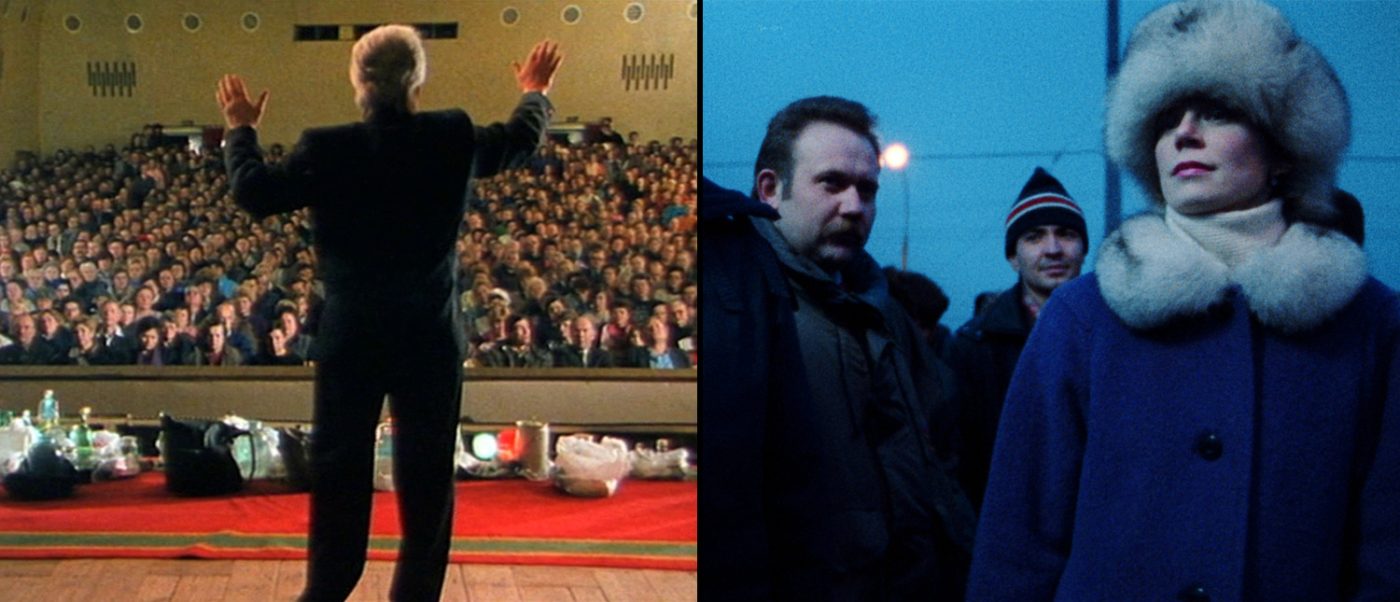
Berlinale’s archival selections – guided by the section head Heleen Gerritsen – unfailingly offer a treasure trove of Cold War paraphernalia from Eastern Europe. Perhaps this is unsurprisingly, since the scars of the East-West divide that supposedly crumbled apart (we all now know better than that) still loom in the background. Additionally, this year’s edition focused on the aftermath of that war with the retrospective Lost in the 90s, offering rather obscure and fascinating gems and inviting reflection on another time of uncertainty and disarray.
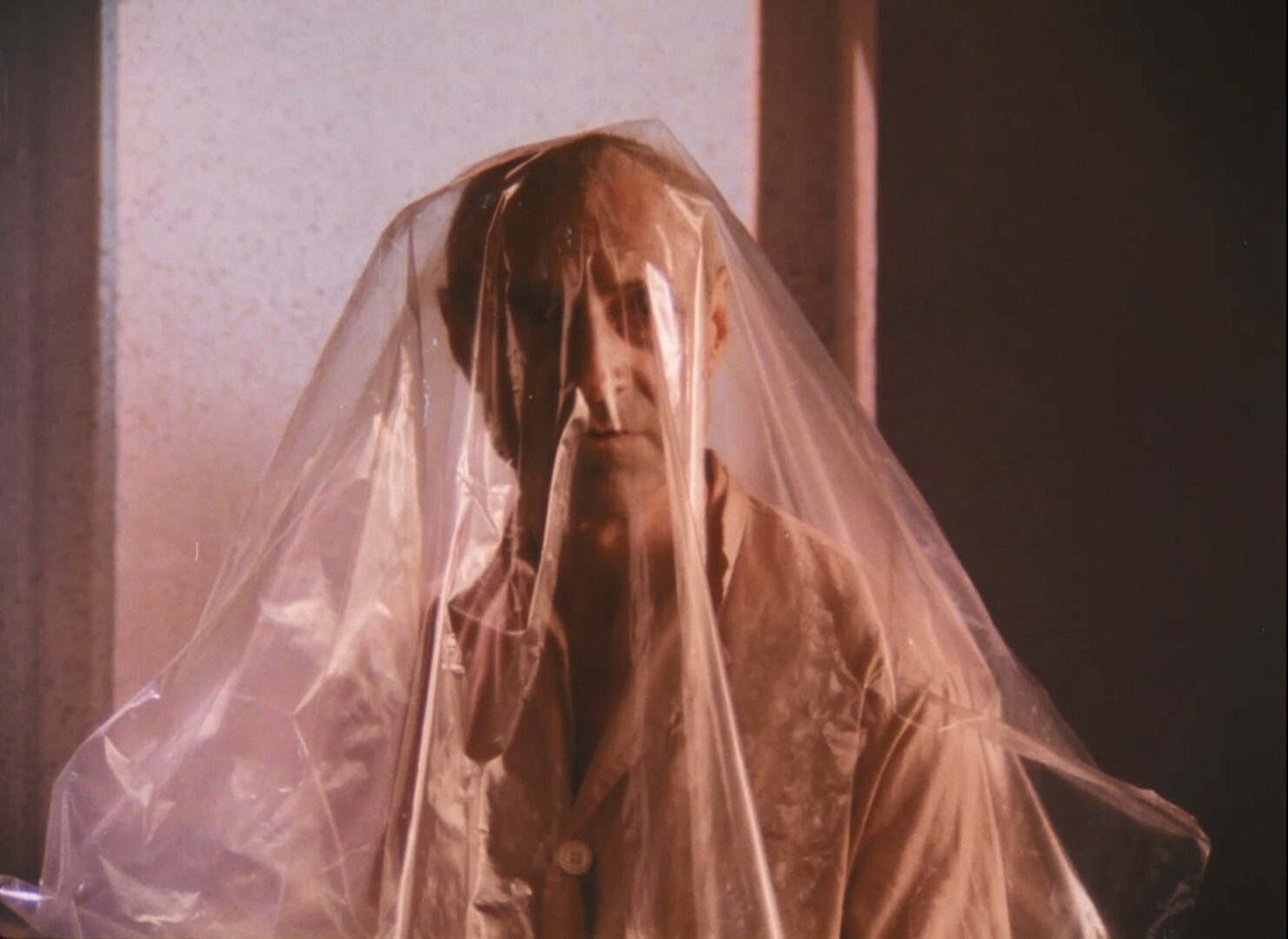
The absolute highlight of this year’s festival was as astounding as the fact that it is so little known. The first narrative film about the Chernobyl disaster, Raspad («Decay», 1990), came from Soviet Ukraine – strangely co-produced with the US – and premiered at the Venice Film Festival in 1990. This catastrophe thriller took me aback with how brazen it was, even for a Perestroika-era production, in its indictment of the USSR government’s attempts to cover up the nuclear accident. The public lies and private evacuations depicted are only one little piece of the mosaic, however.
What startled me even more was how bloody funny it is. There is havoc and anguish, but also plenty of absurd humour and jabs at petty human behaviour, especially that of the journalist Aleksandr Zhuravlyov (Sergey Shakurov). A lover of a good party, a member of the intelligentsia, a wounded male – his zany odyssey takes us from Kyiv to the Exclusion Zone in Pripyat and glues together the kaleidoscopic narrative of the ensuing tragedy.
Chaotic, fast-paced and with thrilling cinematography: watching Raspad feels a little like watching Fear and Loathing in Las Vegas (1998), Soviet style. Only it is far from frivolous. Despite the living, breathing camerawork, Raspad (Decay) is more interested in how quickly radiation corrupts the social fabric rather than the physical body. Every man for himself and his own, then, no matter the circumstances.
I would have thought the film’s attitude to society a little shocking and cynical had we not ourselves witnessed how natural such things are. Well, fair enough. We’ve seen for ourselves that the ego doesn’t vanish just because the air becomes poisonous. During the screening, it occurred to me that nowadays you could hardly get away with a film about a tragedy of such proportions with such a funny disposition. How they made it then is beyond me.
Another surprisingly zany exposé of the un-communal reality of the communist utopia came from Czechoslovakia. Panelstory, aneb jak se rodí sídliště («PanelStory, or How a Housing Development Is Born», 1980), written and directed by the legendary Věra Chytilová, is quite a romp from the late-70s. With action-packed crime-thriller pacing and camerawork to make your head spin for days, Věra Chytilová chose no prefabricated cinematic conventions for a critique of bourgeois individualism hidden behind socialist modernity.
Spanning a single day around a construction site of a new prefab housing development in Prague, this frantic satire follows an ensemble cast that is always just one step away from tragedy. An unsupervised child runs around the site with plenty of curiosity yet no self-preservation instinct; an elderly gentleman wanders about, unable to find the apartment he’s meant to move into; a girl chases after her good-for-nothing boyfriend who’s knocked her up… All the while the half-finished building is already inhabited, already falling apart, with death or birth or both ready to sanctify the site at any moment.
The sham happiness of nuclear families, the breakdown of neighbourliness, and not-my-problem attitudes: these are prescient depictions of human behaviour as timely as ever. Withheld by the authorities from distribution until 1981, this overwhelming feminist comedy now enjoys its premiere in a digital restoration.
Back to the 90s, Dušan Makavejev’s last feature film Gorilla Bathes at Noon from ’93 was an unlikely hodgepodge of perspectives on the so-called end of history. An English-language comedy directed by a Serbian about a Russian soldier stuck in reunified Germany… Unsurprisingly, the film deals with losing one’s footing due to the cataclysms of history. As Major Lazutkin (Svetozar Cvetković) gets abandoned by fellow Red Army officers and his wife back home, he gallivants through Berlin with wit and charm to spare, no word of German, and always a Soviet flag by his side – no more than a walking souvenir of what used to be his life.
His naïve shenanigans and philosophical musings land him in all kinds of dubious situations, especially as Lazutkin is still an earnest believer in Soviet communism. His father’s war memories are plucked from the over-the-top propaganda film The Fall of Berlin, his fever dreams involve increasingly lustful encounters with Lenin (delightfully, Anita Mančić in drag) – he is a relic of a ‘new Soviet man’ rather than late-stage homo sovieticus. So how do you move on when your identity and lived experience are proclaimed to be null and void, wiped out overnight? What is one wont to do with the weight of history? Dušan Makavejev throws his hands up in the air. Almost thirty years on, the question still remains.
It would be amiss not to mention another Serbian eccentricity, Tito pro drugi put među Srbima («Tito Among the Serbs for the Second Time», 1994), in which the literal ghost of Tito (Dragoljub Ljubičić) is resurrected by Želimir Žilnik to check in on his people in 1994. It is not a scripted comedy – although at times it is very funny – but a recording of a happening in Belgrade in which Tito comes back to argue with passers-by about whose fault it really is that Yugoslavia collapsed. With the bloodshed of the Yugoslav Wars in the background, Želimir Žilnik reflects on the absurdity of those times by embracing it and reflecting it back onto the society in which things previously deemed unthinkable can suddenly become a matter-of-fact.
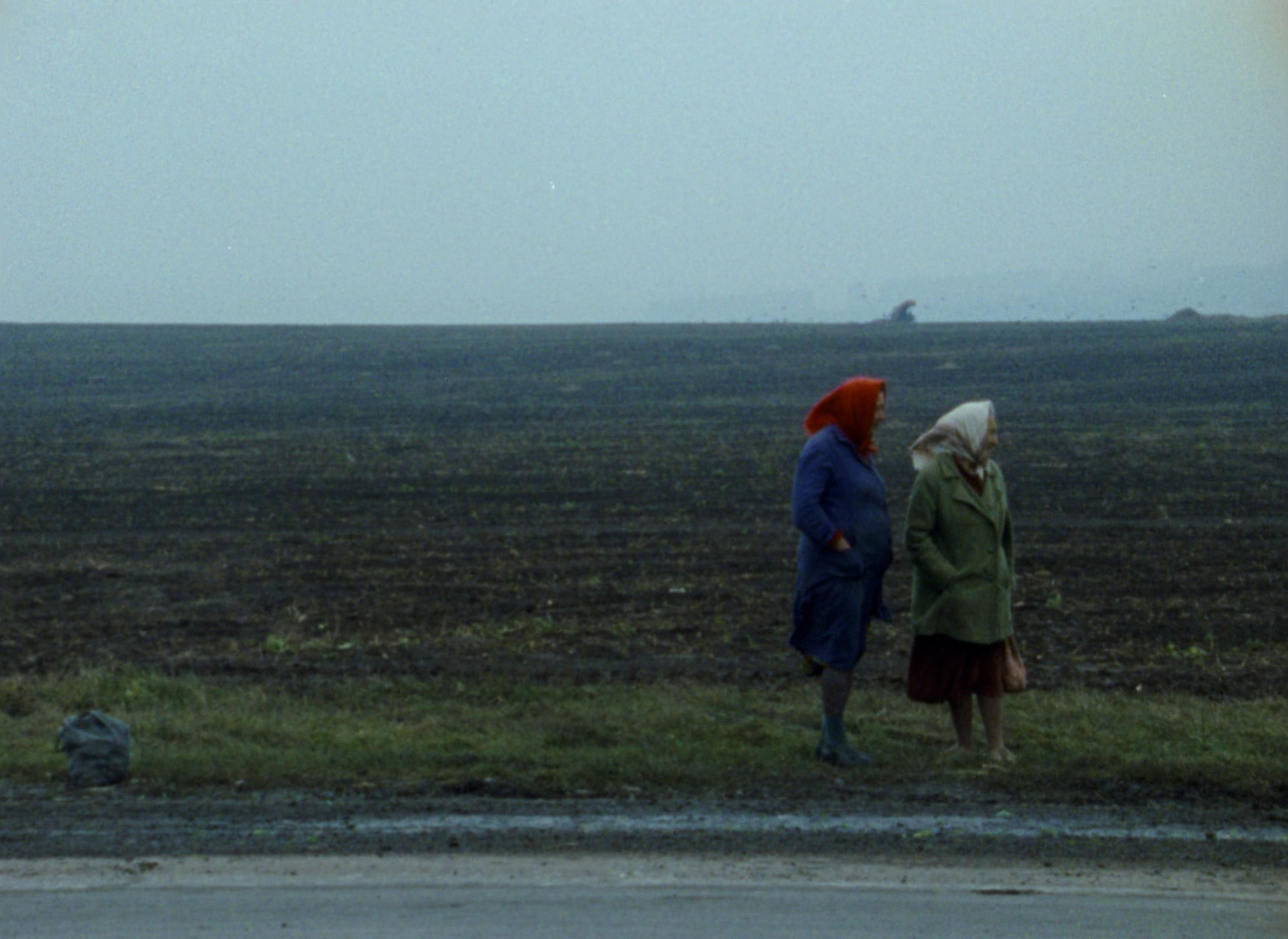
So far, the search has brought no answers and revealed that, if anything, people have been as much at a loss then as now on how to live in a world that is falling apart. The absence of vitality and spirit in the region that once dreamt of a utopia, only for it to quickly turn into a decades-long nightmare, is a haunting sight in D’Est («From the East», 1993) by Chantal Akerman.
A travelogue of sorts, a 16-mm record of her road trip through the former East Germany, Poland, Ukraine and Russia after the collapse of the Communist Bloc, it documents the lacklustre movements of people who woke up from one nightmare to find themselves in a new one. Simultaneously veridical and elusive, embellished with neither score, narration, nor subtitles – with Chantal Akerman’s unmistakable pacing, D’Est glides through spaces made immense, spaces in which the living ghosts queue or dance or walk through a collapsed order, waiting for the chaos to subside.
Repetition reigns, as in much of her oeuvre, and the cyclicity of images and decelerated time allow the viewer to interrogate the naturalised gaze of the travelogue format. The position of the cameraperson, and therefore ours, is slowly called into question by the locals whose lives are intruded upon while, paradoxical, the absence of translation only emphasises the absurdity of the claim that one can ever comprehend a land or a people. And so Chantal Akerman simply records, and it becomes a document of waiting, waiting through a colossal, liminal time.
D’Est almost seems like a film about nothing, occupied with idle human beings stripped of rhetoric. Almost. Tchaikovsky’s «None but the Lonely Heart», sung in Russian, reverberates through a packed yet still train station. We never see the man whose isolated voice deflects off the people waiting. Whose loneliness does he lament? The documentarist’s? Ours, the audience members in the crowded solitude of a cinema hall, idling away a Saturday night? That of every face on the screen, or his own? There is no difference. The only thing we all ever share is loneliness. No one drives the point home like Chantal Akerman.
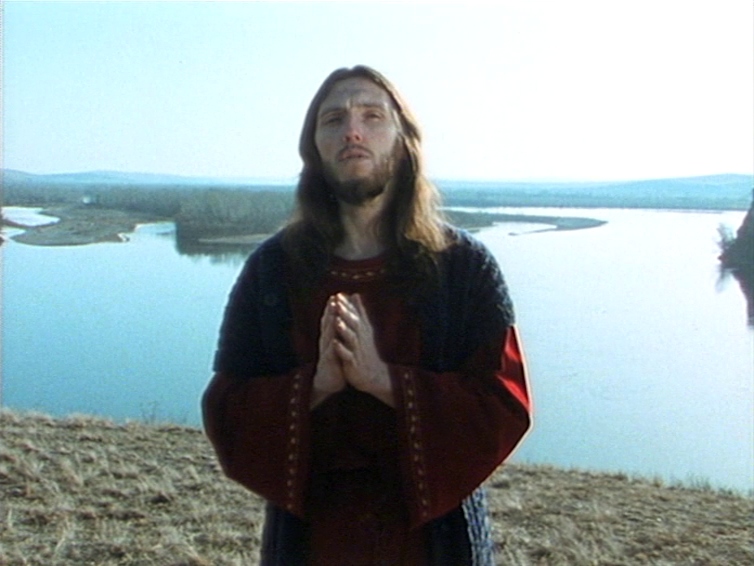
Of course, the only antidote to isolation – and feeling helpless and overwhelmed by the state of the world does lead to isolation – is community. And community can be a double-edged sword. Released in the same year as Chantal Akerman’s travelogue, Werner Herzog’s documentary Bells from the Deep: Faith and Superstition in Russia (or a docufiction, more accurately) reveals how the collapse of the Soviet Empire in Russia birthed something opposite of a spiritual crisis – a flourishing of religious fervour.
Without going into the context of prior religious suppression under Soviet atheism, it explores esoteric practices centred around the Russian Orthodox church, while also including some nomadic faiths, all in order for Werner Herzog to look for the key to that favourite Slavic-orientalist fantasy, “the Russian soul.” Somewhat appropriately, he finds plenty of charlatanism, instead.
Werner Herzog follows faith healers and cult leaders, interviews rural elderly folks about their supernatural experiences, and observes group exorcisms. The images are often beautiful and all full of sorrow: indigenous Siberians throat sing while rafting down the river, and pilgrims listen for the eponymous bells of the mythical sunken city Kitezh whilst crawling around Lake Svetloyar in blooming spring. In winter, they crawl on the ice, instead – although that is one of the parts that is staged, shot with local drunkards instead of pilgrims.
While Werner Herzog is transparent about the embellishments he generally seeks for the sake of a ‘poetic truth,’ you would not gather that much from the film itself. By taking this license, he claims to know the Russian people and, presumably, other ethnic groups present, and so his depictions of reality adorned are to be understood as accurate interpretations. What intrigues me more is not the ethics of documentary practice but the very claim of a knowable people.
Here, he works in stark contrast to Chantal Akerman. D’Est (From the East) could be said to uphold the ‘right to opacity,’ a term coined by Édouard Glissant that advocates for an acceptance of the cultural differences between peoples, and that does not seek to analyse, categorise, or strip cultures of their inherent mystery and complexity. No claims to comprehension, no projections. Certainly difficult to make any kind of anthropological study this way.
Not to say that Bells from the Deep: Faith and Superstition in Russia is terribly problematic – Werner Herzog has a compass for the people you would pass by on the street without a second glance, but who in this piece reveal rich and bizarre (and I do not use the latter word lightly) worlds within. The focus on the provinces is apt – while Moscow is in general mayhem, you wouldn’t think of it while watching the film. Werner Herzog shows us the places where societal collapse seems to be but an echo, and the need for genuine faith comes from a life’s toil as continuous and assured as the ringing of the church bells. As my favourite Lithuanian saying goes, “Gyvenimas tai ašarų pakalnė.” Life is but a vale of tears.
The weight of history hangs heavy on Eastern Europe, no matter how quickly we try to run away from it. I drag it with me each day and, when I glimpse the ruins of the Berlin Wall as I cycle past, I echo, without pride, the sentiment expressed by Belarusian Irina Pismennaja directed at western feminists in the documentary Oranzhevye zhilety («Orange Vests», 1993), “Oh, how I would love to have your problems!” During the last two years of the Soviet Empire, she with Ella Milova and director Yury Khashevatsky documented the abuses of this once-utopia. Come and see, they beckon. For someone unfamiliar, their findings can certainly give some perspective.